4-3-2-1 Formation
The 4-3-2-1 football formation (or 4-3-2-1 soccer formation), often called the Christmas Tree formation, uses four defenders, three central midfielders, two attacking midfielders, and a lone striker. It packs the centre of the pitch, creates overloads between the lines, and asks the wide attacking threat to come from full-backs or late midfield runners. This guide covers how the 4-3-2-1 works and how to set it up.
Key facts
- Players
- 11-a-side
- Defensive line
- Flat back four
- Midfield
- Three central players
- Attack
- Two No.10s and one striker
- Difficulty
- Advanced
Overview
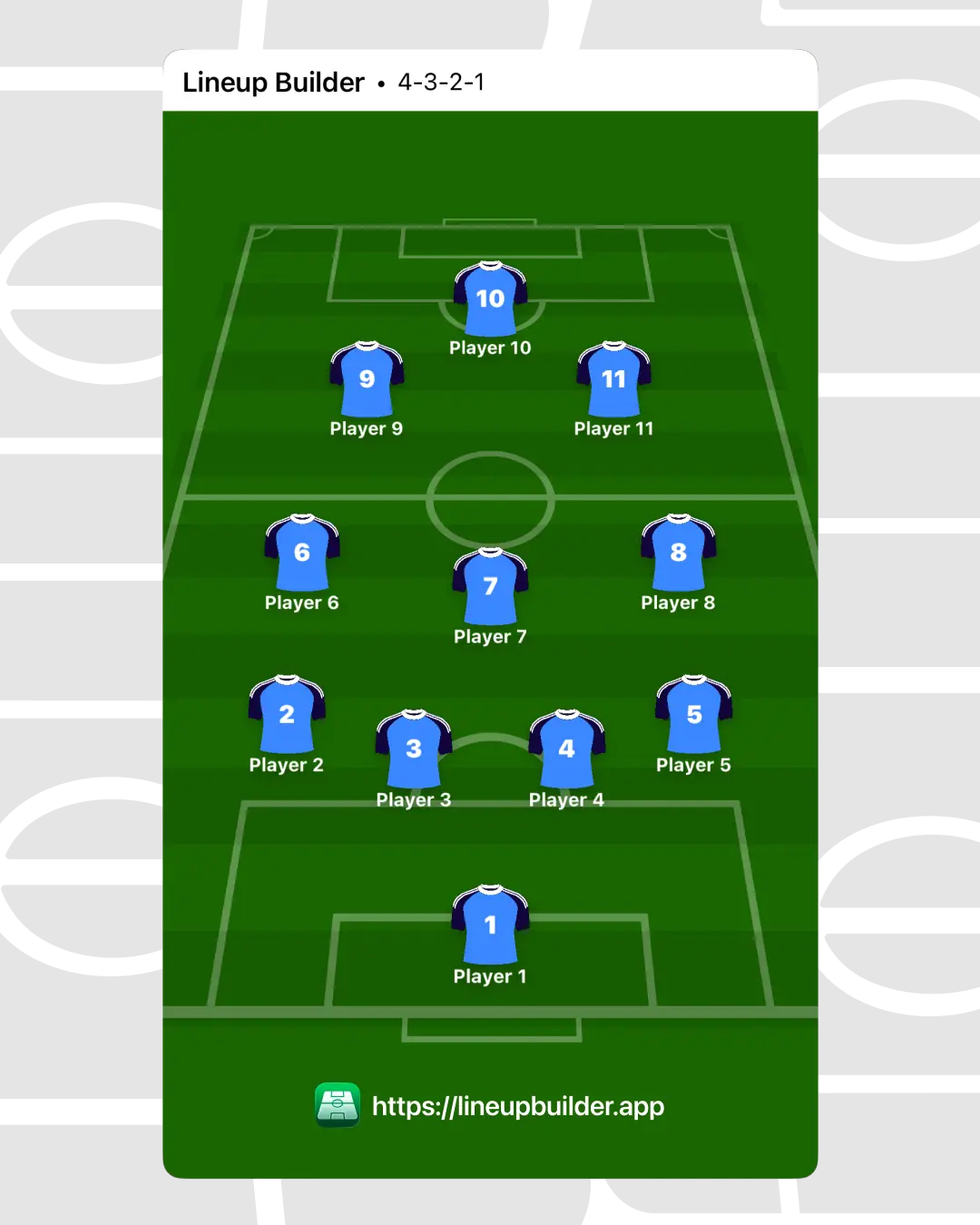
When to use it
- Teams with technical midfielders and creative playmakers.
- Coaches who want to dominate central areas and play between the lines.
- Squads with attacking full-backs who can provide width.
- Sides comfortable rotating positions in the final third.
Advantages
- Extremely strong through the middle with three midfielders and two playmakers.
- Creates constant overloads between the opposition midfield and defense.
- The Christmas Tree shape is compact and hard to break down centrally.
- Ideal for technical teams that like short combinations and central penetration.
Disadvantages
- Lacks natural width, so full-backs must attack and defend the whole flank.
- Can become predictable if opponents pack the central channels.
- The lone striker needs constant support from the two attacking midfielders.
- Requires high tactical discipline and intelligent movement off the ball.
How to set it up
- Set a flat back four with full-backs ready to provide attacking width.
- Add a holding midfielder to protect the defense and start build-up.
- Place two box-to-box midfielders ahead of the pivot.
- Position two attacking midfielders behind the striker as dual No.10s.
- Lead the line with a mobile striker who drops in and opens lanes for the playmakers.
Common variations
Classic Christmas Tree
A clear 4-3-2-1 with two free No.10s operating just behind a lone striker.
4-3-2-1 (Narrow)
The attacking midfielders stay very central, relying entirely on overlapping full-backs for width.
4-3-2-1 to 4-5-1
When defending, the two No.10s drop into midfield to form a compact 4-5-1 block.
Famous teams and contexts
- Associated with Carlo Ancelotti's Milan sides and the classic Christmas Tree shape.
- Used by coaches who want central overloads without traditional wingers.
- A favourite system for teams built around creative attacking midfielders.
Frequently asked questions
What is the 4-3-2-1 football formation?
The 4-3-2-1 football formation (also called the 4-3-2-1 soccer formation) is a lineup shape used to organise players on the pitch. This guide covers its roles, strengths, weaknesses, and when to use it.
Why is the 4-3-2-1 called the Christmas Tree?
Because the shape tapers as it goes forward: four defenders, then three midfielders, then two attacking midfielders, and finally one striker at the top, resembling a Christmas tree.
What is the biggest weakness of the 4-3-2-1?
The lack of natural width. Without wingers, the team depends on full-backs and late midfield runners to stretch the pitch, which can leave spaces on the counter.
What is the difference between 4-3-2-1 and 4-2-3-1?
The 4-2-3-1 uses a double pivot and one dedicated No.10 with two wide attackers, while the 4-3-2-1 uses three central midfielders and two No.10s with no natural wide forwards.
Who is the most important player in a 4-3-2-1?
The two attacking midfielders are crucial for creativity, but the system also depends heavily on full-backs for width and a holding midfielder to protect transitions.