4-2-3-1 Formation
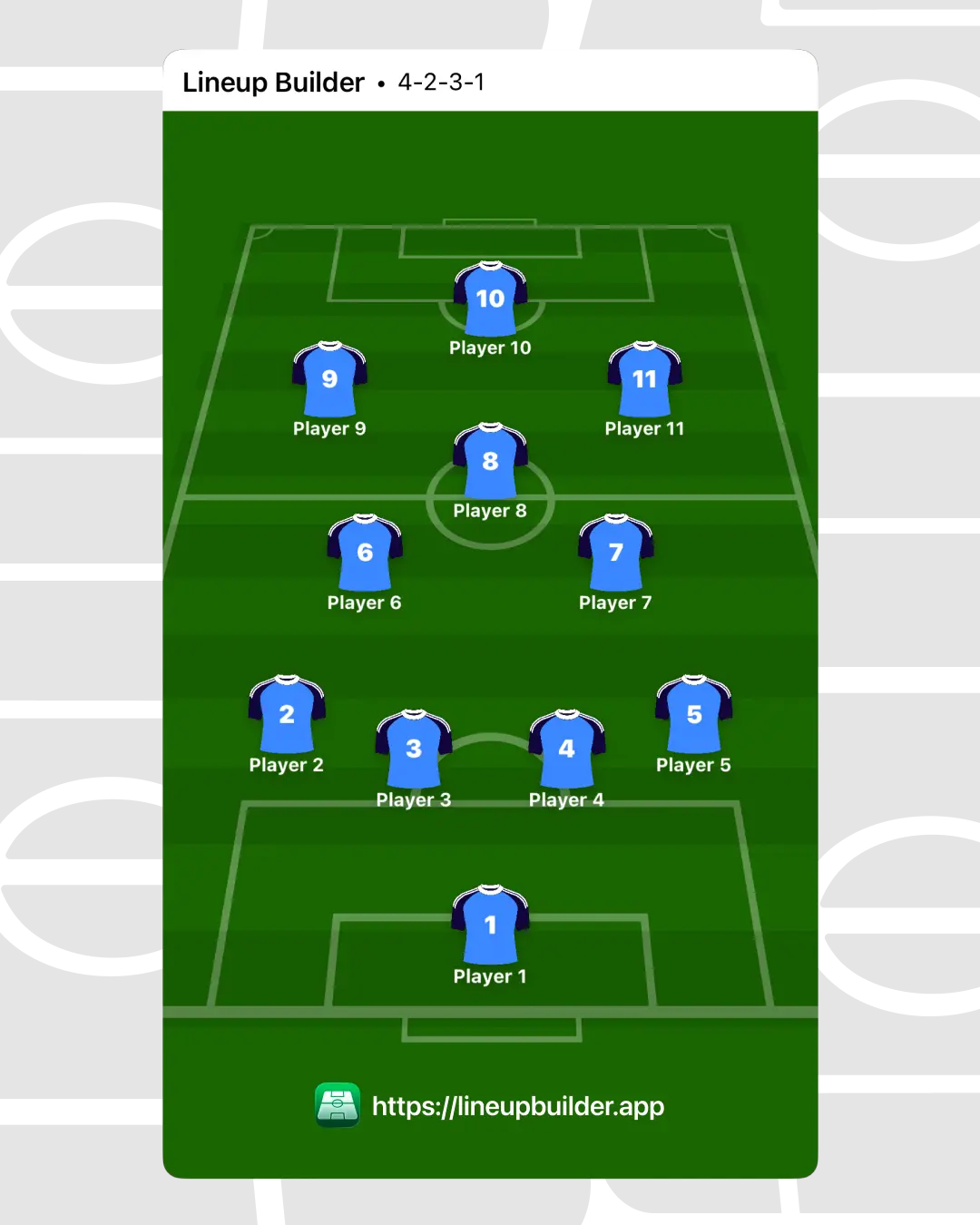
The 4-2-3-1 football formation (or 4-2-3-1 soccer formation) is one of the most balanced and popular modern formations. A double pivot protects the defense while an attacking midfielder and two wingers supply a lone striker. This structure blends defensive security with creative freedom, which is why so many professional teams rely on it. Here is how the 4-2-3-1 works and how to set it up.
Key facts
- Players
- 11-a-side
- Defensive line
- Flat back four
- Midfield
- Double pivot + a number 10
- Attack
- Two wingers, one striker
- Difficulty
- Intermediate
Overview
When to use it
- Teams that want defensive stability with an attacking focal point.
- Squads with a creative playmaker to occupy the number 10 role.
- Coaches who like to control tempo and transition safely.
- Sides that want a flexible base that morphs into other shapes.
Advantages
- The double pivot gives excellent protection to the back four.
- A dedicated number 10 provides consistent creativity between the lines.
- Balanced defensively and offensively, suiting most game states.
- Easy to switch to 4-4-2 or 4-3-3 shapes during a match.
Disadvantages
- The lone striker can be isolated without quick support.
- Relies heavily on the number 10 being in good form.
- Wingers must track back to avoid overloading the full-backs.
- Can become passive if the two pivots sit too deep.
How to set it up
- Set a flat back four with two center-backs and two full-backs.
- Add two holding midfielders side by side as a double pivot.
- Position an attacking midfielder centrally as the number 10.
- Place two wingers wide to support attacks and stretch the defense.
- Lead the line with a single striker who links play and finishes chances.
Common variations
Balanced 4-2-3-1
The classic version with two disciplined pivots and a free number 10, ideal for controlling matches.
4-2-3-1 (Wide)
The wingers stay very high and wide to create one-vs-one duels and early crosses for the striker.
4-2-3-1 (Narrow)
The wingers tuck inside to support the number 10, turning the attack into a fluid central overload.
Famous teams and contexts
- Real Madrid have used the 4-2-3-1 in several successful seasons.
- Germany's 2014 World Cup-winning side built around a strong double pivot.
- Many top clubs use it as a flexible default shape.
Frequently asked questions
What is the 4-2-3-1 football formation?
The 4-2-3-1 football formation (also called the 4-2-3-1 soccer formation) is a lineup shape used to organise players on the pitch. This guide covers its roles, strengths, weaknesses, and when to use it.
Is the 4-2-3-1 a defensive or attacking formation?
It is one of the most balanced formations. The double pivot offers defensive protection while the number 10 and wingers provide attacking threat, making it effective in almost any game state.
What is a double pivot in the 4-2-3-1?
A double pivot is the pair of holding midfielders who sit in front of the defense. They shield the back four, break up attacks, and start build-up play from deep.
What is the difference between 4-2-3-1 and 4-3-3?
The 4-2-3-1 uses two holding midfielders and a dedicated number 10, while the 4-3-3 uses a three-player midfield without a fixed advanced playmaker. The 4-2-3-1 is often seen as more defensively balanced.
Who is the most important player in a 4-2-3-1?
The number 10 is usually the creative focal point, but the system depends on the double pivot working hard to protect the defense and connect play.