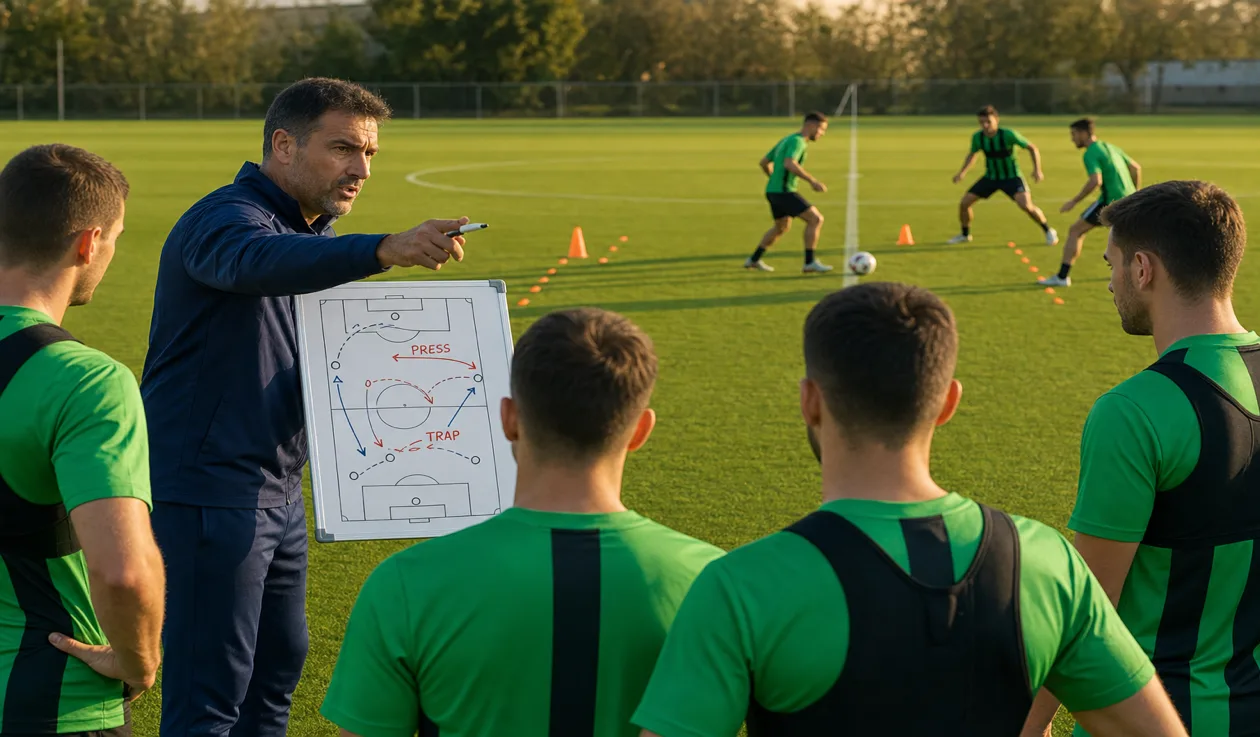
A high press is one of the most talked-about ideas in modern football, and one of the easiest to get wrong. Done well, it creates chances from turnovers close to goal and forces opponents into rushed decisions. Done poorly, it leaves huge gaps behind your defense and burns your players out by half-time.
This guide explains what a high press really is, how to set the triggers, which formations support it, and how to decide whether it fits your squad.
What high pressing actually means
High pressing is not “everyone sprints at the ball.” It is a collective plan to win possession in the opponent’s half by:
- closing the player on the ball
- blocking the next easy pass
- keeping the rest of the team compact behind the press
- reacting instantly if the first wave is beaten
The aim is to force a mistake — a loose touch, a panicked clearance, or a pass into a trap — and then attack while the opponent is disorganized.
Pressing triggers that keep the team together
Without shared triggers, a press collapses into individual chasing. Teach your players a short list they can recognize in real time.
Common triggers
- A back pass to the goalkeeper or center-back — the cue to step up and shut down the next option.
- A heavy or sideways touch — the ball carrier is temporarily off balance.
- A full-back receiving under pressure — often the weakest link in the build-up.
- A pass into a pre-agreed trap zone — for example, forcing play into the wide channel where your winger and full-back converge.
Roles inside the press
Every player needs a job, not just the forwards:
- First presser — forces the ball one way.
- Second presser — cuts the obvious escape pass.
- Cover players — stay tight to nearby receivers and protect the center.
- Rest defense — usually the back line and a holding midfielder, ready if the press is broken.
- Goalkeeper — starts higher, sweeps behind the line, and communicates when to step or drop.
Formations that support a high press
The formation does not press for you, but it can make the distances and angles much easier.
4-3-3
The 4-3-3 is the classic pressing shape. The front three can screen the back line, the midfield three stay compact, and full-backs push up to lock the flanks. It works best with energetic wingers and a midfield that can jump together.
4-2-3-1
The 4-2-3-1 gives you a double pivot for rest defense and a number 10 who can press the deepest midfielder. It is flexible: press high when the chance is there, then drop into a mid block without changing personnel.
4-4-2
The 4-4-2 presses with two strikers who can split and screen central passes, while the midfield bank of four stays compact. It is often the simplest pressing structure to coach at amateur and youth level.
3-4-3 and 3-5-2
The 3-4-3 and 3-5-2 can press aggressively if wing-backs step high and the midfield stays connected. The trade-off is clear: if the first line is beaten, the space behind the wing-backs becomes a highway unless the back three is well coached.
Map each shape in Lineup Builder before match day so every player sees their pressing lane, not just their starting spot.
The risks you must plan for
A high press creates danger both ways. Build your Plan B before kickoff.
- Space in behind — long balls over the top punish a high line.
- Fatigue — pressing for 90 minutes without rotation destroys intensity after the hour mark.
- Overcommitment — if two players jump at the same ball, the next pass splits your shape.
- No counter-press — winning the ball high is useless if the first pass after the turnover is careless.
When the press is broken, the team needs a clear rule: delay, drop into a mid block, or counter-press for three seconds and then reset. Ambiguity here is where goals against are born.
How to decide if high pressing fits your team
Ask these questions honestly before you commit:
- Do we have runners? Forwards and midfielders who can press repeatedly without disappearing after 60 minutes.
- Are our center-backs comfortable in open space? A high line needs pace, anticipation, or a sweeper-keeper.
- Can we coach one shared trigger this week? If not, start with a mid block and add selective high presses later.
- What is our Plan B? A drop into a 4-5-1 or a deeper 5-3-2 can protect a lead without abandoning structure.
If the answers are weak, you do not need to abandon aggression — you need to press in moments, not as a permanent lifestyle.
A simple training progression
You do not need a professional staff to install a usable press.
- Rondos with a high-recovery rule — points for winning the ball in a designated zone.
- 3v2 / 4v3 build-up vs press — teach the first and second presser to work as a pair.
- Half-pitch 8v8 with triggers — freeze play when the trigger appears and check distances between lines.
- 11v11 with one clear cue — for example, press only on back passes for the first two weeks.
Keep feedback short and visual. Show the shape on a board, then walk players into their lanes on the pitch.
Bringing it together
High pressing is a team skill built on shared triggers, short distances, and a reliable rest defense. Choose a formation that matches your players, rehearse one cue until it is automatic, and always know what happens when the first wave fails.
The coaches who get the most from a high press are not the most aggressive — they are the most organized. Build the lineup, assign the roles, and test the shape until every player knows when to jump and when to hold.